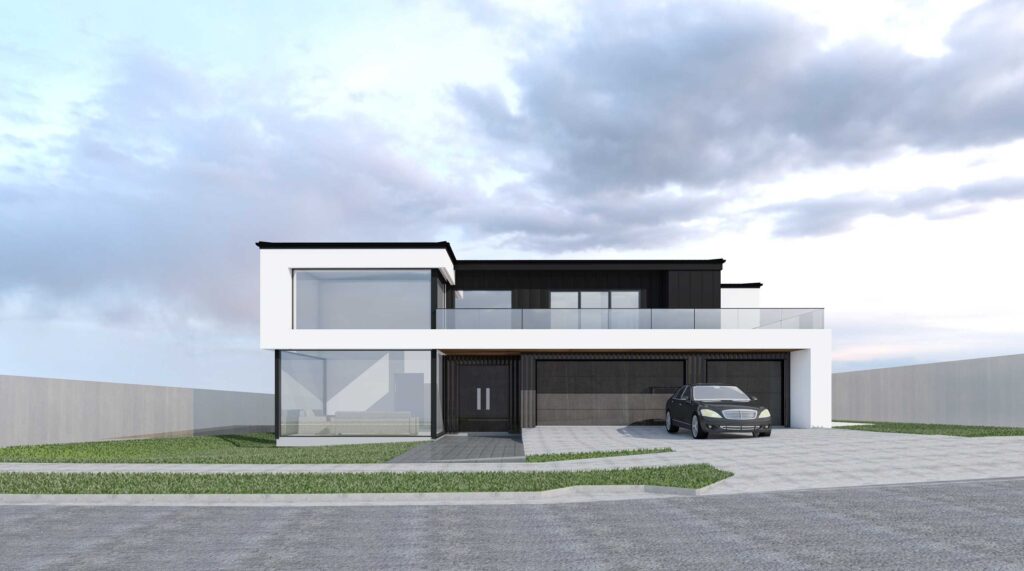
Every architect or architectural designer in New Zealand who applies for building consent faces the same question.
“Is this building designed and intended to last at least 50 years?”
I believe many hesitate for a moment before clicking “Yes.” Others might simply press the button without a second thought, without attaching any meaning to it.
I always belong to the former. Every time I click “Yes,” I do so with a heavy sense of responsibility pausing to reflect on my project and asking myself once more:
The work I have fallen in love with will it really be okay? Will it truly last at least 50 years?
Beyond the Building Act 2004 and the Building Code, I ask myself and my team.
From an aesthetic perspective, from an urban planning perspective, will this building truly stand here for more than 50 years? Will people still love it then? Will it harmonise with the city around it? If not, is it right for me to click “Yes”?
I believe this is the philosophical question every designer must face.
I am a Licensed Building Practitioner who has been designing architecture for more than 15 years in Spain, Korea, and here in New Zealand, Aotearoa, yet I still hesitate to say with certainty that any design will have a 50-year lifetime. Who truly knows?
Government planning strategies and housing development policies may change. The site might gain more potential than I originally envisioned, and the building could be demolished after 10 or 49 years due to these changes. Or a devastating natural disaster like the February 2011 Christchurch earthquake or Cyclone Gabrielle in February 2023 might strike and sweep it away.
I am not a psychic, nor someone with supernatural powers who can see the future. I cannot guarantee that this building I cherish will still stand 50 years from now. Yet I dream that it will be loved for 50, even 100 years living on through generations, blending naturally into the urban landscape, and enduring through time.
And so, I click “Yes” with that architect’s mindset, with that sense of responsibility, as part of my profession.
Contemporary urban environments increasingly face a quiet paradox: while density continues to grow, genuine human connection often diminishes. In response, architecture and urban design are re-examining one of their most fundamental roles, not only to shape space, but to cultivate community.
Architecture has the power to bring people together or keep them apart. Thoughtful design can foster community, encourage interaction, and create a sense of belonging.
Shared Spaces
At the heart of this approach is the idea that connection is not accidental. It is designed. It emerges from carefully considered spatial relationships, from the layering of public and private realms, and from the presence of shared landscapes that invite interaction without obligation.
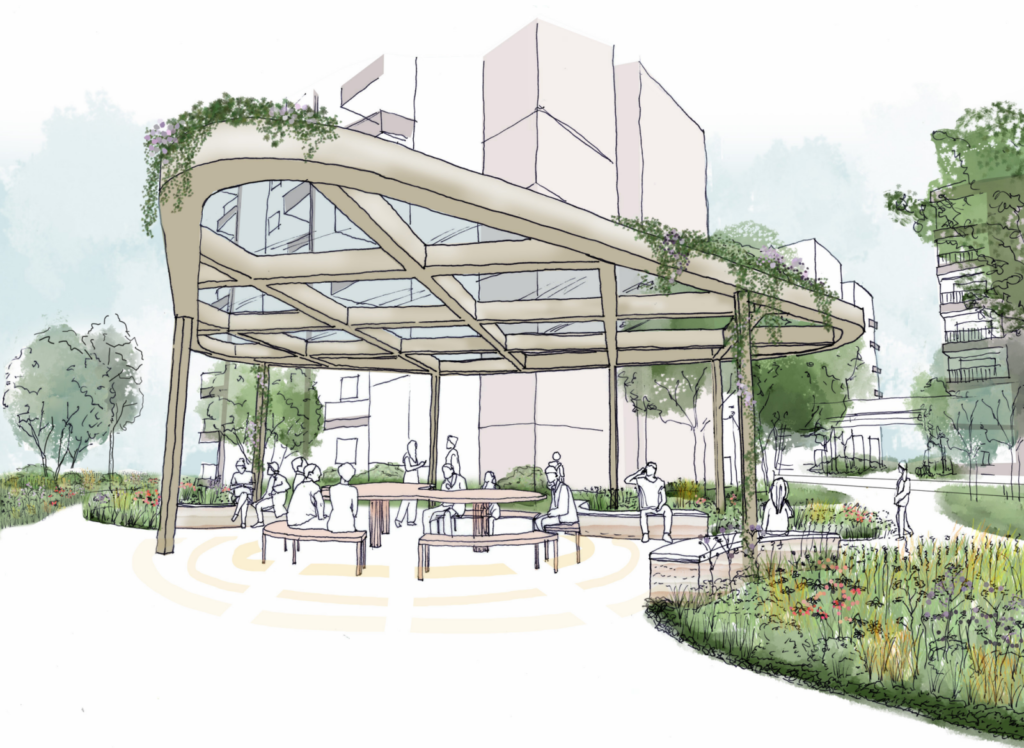
One of the most effective strategies in fostering everyday community lies in the integration of pocket gardens. These small, intimate green spaces act as extensions of the home, offering moments of pause within the urban fabric. They are not grand or performative; instead, their strength lies in their accessibility and familiarity. Here, residents encounter each other in unplanned ways, a brief conversation, a shared moment of care, or simply the recognition of a neighbour’s presence.
Human Scale
Beyond the scale of the immediate dwelling, communal gardens expand this idea into a collective realm. These shared landscapes become social anchors, supporting activities that range from gardening and gathering to quiet observation. Unlike programmed public spaces, communal gardens rely on the subtle choreography of proximity and openness, encouraging interaction while respecting individual comfort.
At a larger scale, the introduction of a green axis within urban planning connects these fragmented moments into a continuous spatial narrative. This linear landscape structure acts as both ecological infrastructure and social framework, stitching together residential clusters, public amenities, and everyday routes of movement. It transforms circulation into experience, allowing nature and community life to coexist along a shared corridor.
Together, these layers, pocket gardens, communal gardens, and green axes form a multi-scalar system of connection. Each operates at a different intensity of privacy and publicness, yet all contribute to a single goal: strengthening the social fabric of the city through design.
As contemporary families become increasingly diverse in structure and lifestyle, the question of how architecture can support both individual independence and collective living grows more relevant. Multi-generational households, in particular, challenge conventional domestic models by requiring spaces that accommodate differing rhythms, needs, and expectations under one roof.
The balance between privacy and connection is therefore not simply a spatial problem but a social one. Architecture must negotiate the delicate threshold between retreat and interaction, allowing family members to maintain personal autonomy while fostering meaningful relationships through daily life.
Living Together, Living Apart
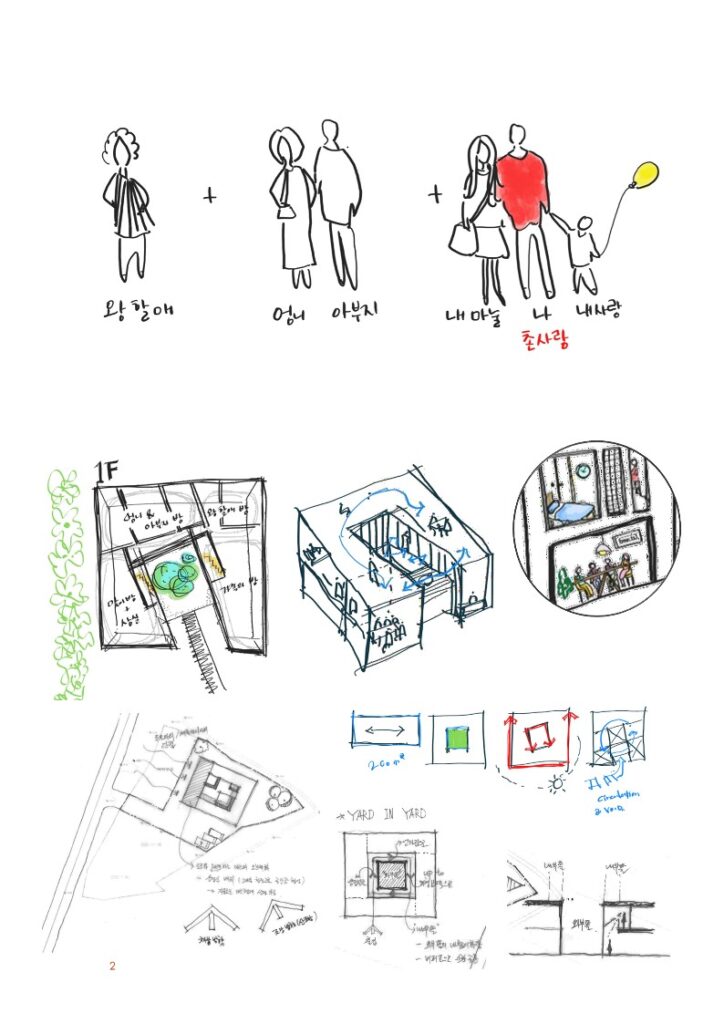
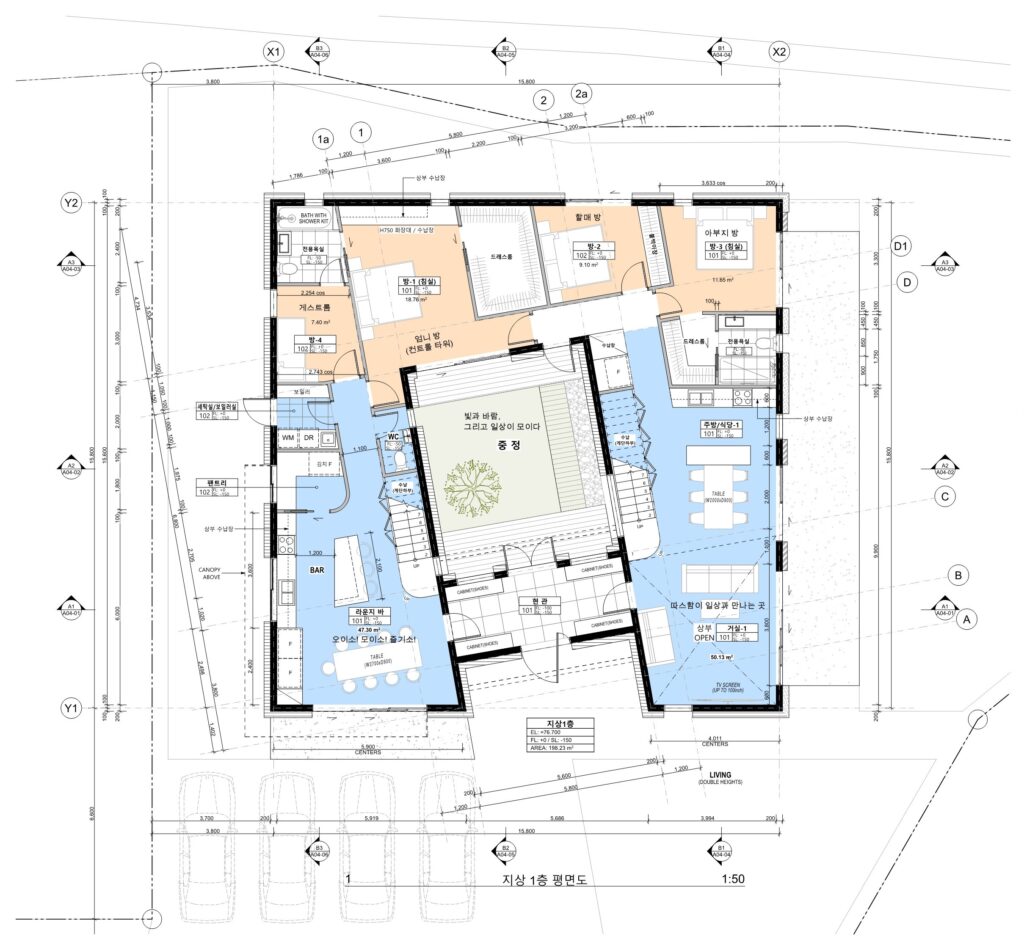
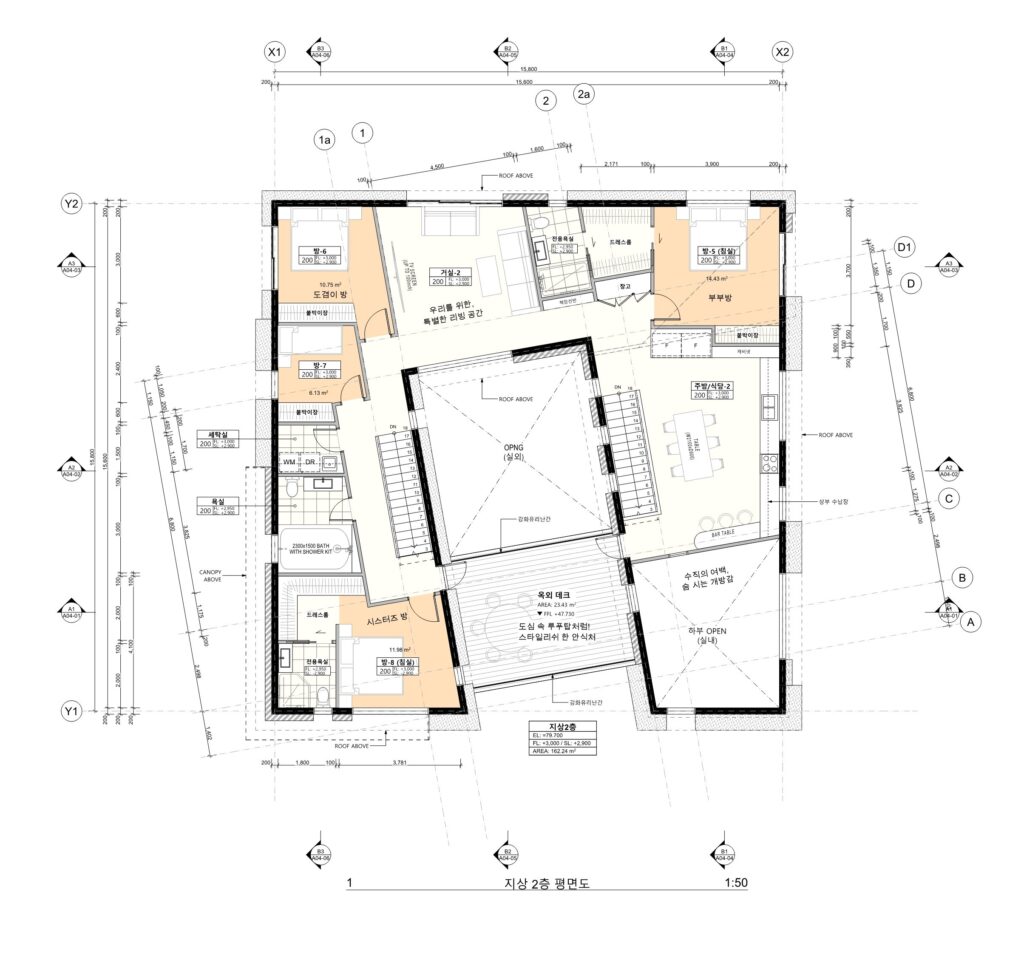
This home is a warm rural dwelling designed for four generations living together, a living arrangement that is increasingly uncommon today, including a married couple and their child, the wife’s parents, and her grandmother. Rooted in the values of family and coexistence, the design carefully balances independence and togetherness.
Each generation is provided with its own sense of territory and privacy, including a dedicated home office for the husband, allowing daily life and work to coexist harmoniously. While the spaces function independently, they are gently connected through a generous central courtyard where views intersect and everyday moments naturally overlap.
Layered Spaces
Creating transitional zones : courtyards, covered terraces, buffer gardens, provides gradual transitions between public and private realms.
Rather than treating shared living as a compromise of personal space, this can frame coexistence as an opportunity for layered living. Independent zones support different generations and modes of life from quiet retreat to focused work while carefully positioned communal spaces become places where relationships are sustained through informal encounters and overlapping routines.
Two distinct vertical circulation paths shape the home, reducing the sense of separation between generations while encouraging casual encounters and meaningful interaction. This layered arrangement supports both personal retreat and shared family life, creating a living environment that adapts to different rhythms and needs.
Four Generations, One Home
Embracing the warmth of rural living, the house bridges the boundaries between city and countryside, between generations, and between interior and exterior. It is a home that reflects the character of its inhabitants grounded, connected, and quietly enduring.
Why do certain buildings become unforgettable?
Timeless Elegance
In an age where architecture often competes for attention through complexity and spectacle, the buildings that remain most deeply embedded in our collective memory are often those built upon clarity. Their forms are simple, their messages direct, and their concepts immediately legible. They are not diluted by excessive gestures or obscured by overcomplicated narratives. Instead, they possess a rare confidence, the power of simplicity.
Iconic Building
An iconic building is not necessarily defined by size, cost, or technological ambition. Its enduring presence comes from something more fundamental: recognisability. People remember architecture that speaks clearly. A strong silhouette, a singular idea, or a form distilled to its essence can become permanently carved into the public imagination.
Simple form does not imply simplistic design. Rather, it demands greater discipline. To reduce architecture to its essential expression requires precision and conviction. Every line, proportion, and spatial decision carries greater weight when there is nowhere for the design to hide.
This is perhaps why people are so deeply drawn to certain designs. They respond not only to visual impact but to conceptual clarity. Architecture with a direct and understandable idea generates an immediate emotional connection. It invites recognition before interpretation.
The most celebrated buildings throughout history often share this quality. Their power lies not in complexity alone, but in their ability to communicate a singular and memorable identity. Such architecture becomes more than a physical object; it becomes an image, a symbol, and sometimes even a cultural memory.
The power of simple form lies precisely here in its ability to move beyond architecture itself. When form and concept align with clarity and purpose, design becomes something people do not merely observe, but genuinely embrace and remember.